
Garage Door Spring and Cable Safety: What Every Homeowner Should Know
Springs and cables do the real lifting on a garage door — the opener motor only guides the motion. Because they hold the stored energy needed to raise a door that often weighs 150 to 300 pounds, they are also the two most dangerous parts of the system to touch. This guide explains where that energy lives, why professionals use purpose-made tools to control it, and exactly where the safe line sits for a homeowner.
Request Service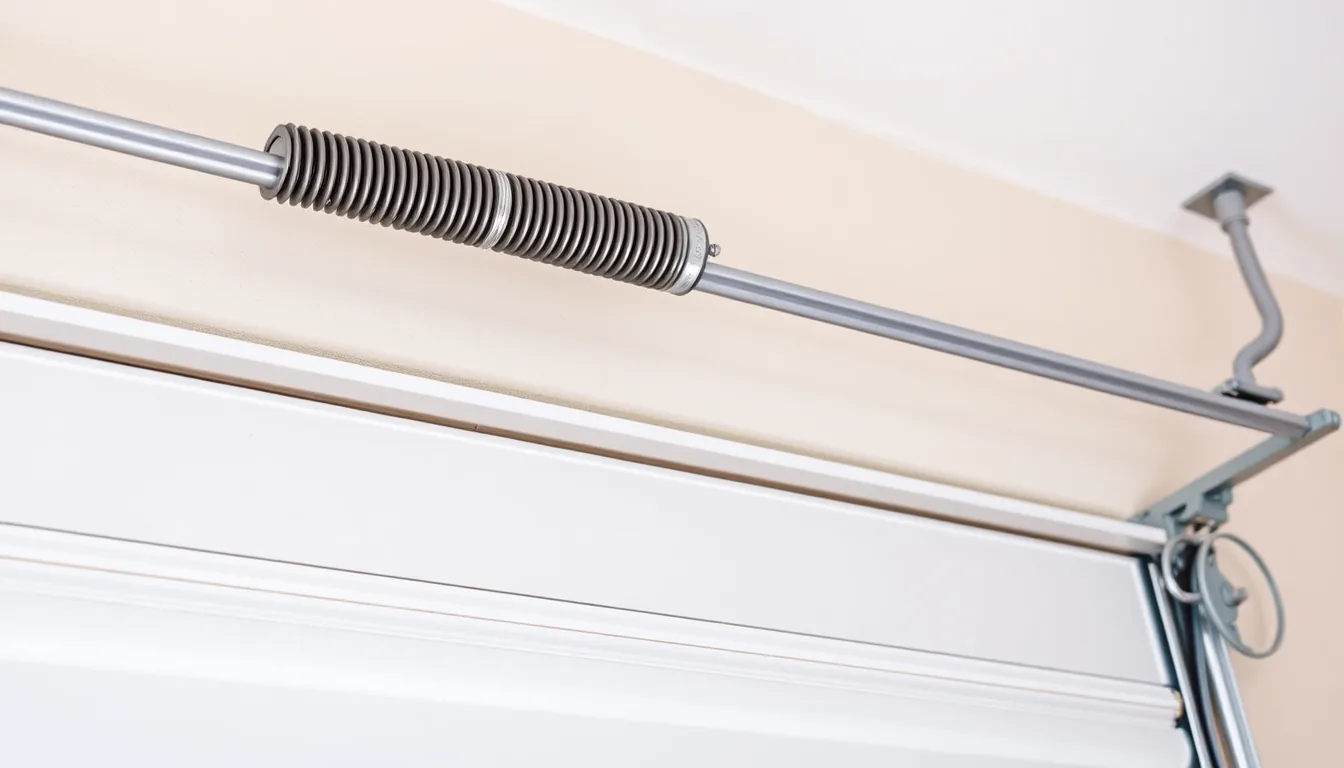
Where the Energy Lives: How Springs Lift a Heavy Door
A typical double-car steel garage door weighs between 150 and 300 pounds, and insulated or wooden doors can weigh even more. No opener motor lifts that weight by itself. The work is done by springs that act as a counterbalance, so the door feels almost weightless when the system is healthy.
Most modern doors use a torsion spring: a tightly wound coil mounted on a steel shaft above the door opening. When the door is installed, that spring is wound under load — a spring for a standard 7-foot door is typically wound about thirty quarter-turns. Every one of those turns is energy stored in twisted steel, waiting to be released. Older or lighter doors may use extension springs instead, which stretch along the horizontal tracks on each side and store energy by being pulled longer.
When a spring breaks, all of that stored energy releases in a fraction of a second. That is the loud bang homeowners describe hearing from inside the house. It is also why a broken spring should only ever be handled by someone trained to control that energy.
Cables Carry the Same Load
Lift cables are the other half of the counterbalance system. Each cable runs from a bottom bracket at the lower corner of the door up to a cable drum on the torsion shaft. When the spring turns the shaft, the drums wind the cables and the cables raise the door.
This matters for safety because the bottom bracket looks harmless. It sits at floor level, held on by a few ordinary bolts, and nothing about it appears to be under load. In reality it is the anchor point for the door's entire lifting force. Unbolting a bottom bracket while the spring is under tension can release that force without warning.
Extension-spring doors have one extra safety feature worth checking visually: a safety cable threaded through the middle of each spring. If the spring snaps, the safety cable keeps the broken pieces from flying across the garage. If your stretched side springs have no cable running through them, that is worth noting in a service request.
What Winding Bars Are and Why Pros Use Them
Torsion springs are adjusted using winding bars: solid, hardened-steel rods, usually about 18 inches long, machined to fit snugly into the holes of the spring's winding cone. A technician uses two bars, keeping one fully seated in the cone at all times so the spring's force is always held by solid steel.
The tool matters because of what people substitute for it. Screwdrivers, pliers, and rebar scraps are the classic improvised stand-ins, and they fail in predictable ways: they are too short for leverage, too soft to resist bending, and too loosely fitted to stay seated in the cone. A bar that slips out of a loaded cone becomes a steel club driven by the full force of the spring.
We describe winding bars here so you can understand the hazard — not so you can attempt the work. There is no safe improvised version of this tool, and even the correct tool requires training to use.
How DIY Spring and Cable Injuries Happen
Garage door injuries are a documented category in hospital emergency department data, and spring and cable work accounts for some of the most severe cases. The common patterns are consistent:
- Hand and finger injuries — lacerations, crushed fingers, fractures, and in serious cases amputation, when a hand is caught by a moving cone, drum, or cable.
- Face and head strikes — a winding bar or substitute tool that slips out of a loaded cone can whip around faster than a person can react.
- Falls — spring work happens on a ladder, and a sudden release of tension is exactly the kind of jolt that causes one.
The scenarios that lead to these injuries usually start small: loosening a set screw on a winding cone "just to look," unbolting a bottom bracket to replace a frayed cable, or unhooking a stretched extension spring with the door down. Each of those actions releases stored energy at a point where a hand is nearby.
The Safe Homeowner Boundary: Observe and Report
There is a clear, useful role for a homeowner in spring and cable problems: be a good observer. All of the following are safe to do with the door closed and the opener unplugged:
- Look at the torsion spring above the door. A break shows as a visible gap of an inch or two in the coil.
- Look at the cables on both sides for frayed strands, rust, or a cable that has jumped off its drum and gone slack.
- Check whether extension springs have safety cables running through them.
- Listen and remember: a loud bang from the garage is the classic sign of a spring letting go.
- Take photos from a safe distance for your service request.
The boundary is just as clear: never unbolt, unhook, loosen, or adjust anything that is attached to a spring or a cable. That includes winding cones, cable drums, bottom brackets, and the spring anchor bracket. If a wrench has to touch it, the job belongs to a technician with the right tools and the correct replacement parts for your door's weight and height.
What to Put in Your Service Request
When you submit a request through our contact form, a few observed details help a technician prepare: whether the door is a single or double, roughly how tall it is (7-foot and 8-foot are the common heights), whether the springs sit above the door or along the tracks, and what you saw or heard — a gap in the coil, a slack or frayed cable, a bang, or a door the opener strains to lift. Describe the problem, attach photos if you have them, and leave the door closed until it can be assessed.
Frequently Asked Questions
Can I replace a garage door spring or cable myself?
We strongly advise against it. A wound torsion spring stores the energy needed to lift a door weighing 150 to 300 pounds, and releasing that energy incorrectly causes serious, well-documented injuries to hands, fingers, and the head. The work also requires correctly sized replacement springs matched to your door's weight, plus proper winding bars. The safe path is to note the symptoms, keep the door closed, and submit a service request so a technician can handle the tensioned parts.
What does a broken torsion spring look like?
Look above the closed door at the coiled spring on the horizontal shaft. A broken torsion spring shows a clear gap of about one to two inches where the coil has separated. Other signs support the diagnosis: a loud bang heard earlier, a door that suddenly feels dead-heavy, or an opener that strains and gives up a few inches off the floor. If you see a gap, stop using the door and describe what you found in your service request.